
Knowledge poverty is one of the quiet crises of modern academia.
It does not come from a lack of data, instruments, or funding alone—it comes from a shortage of questions.
Many Early Career Researchers (ECRs) are trained brilliantly in laboratory skills. From undergraduate labs to graduate projects and postdoctoral appointments, they master techniques, protocols, software, and instruments. This technical excellence is valuable—but it is not the job.
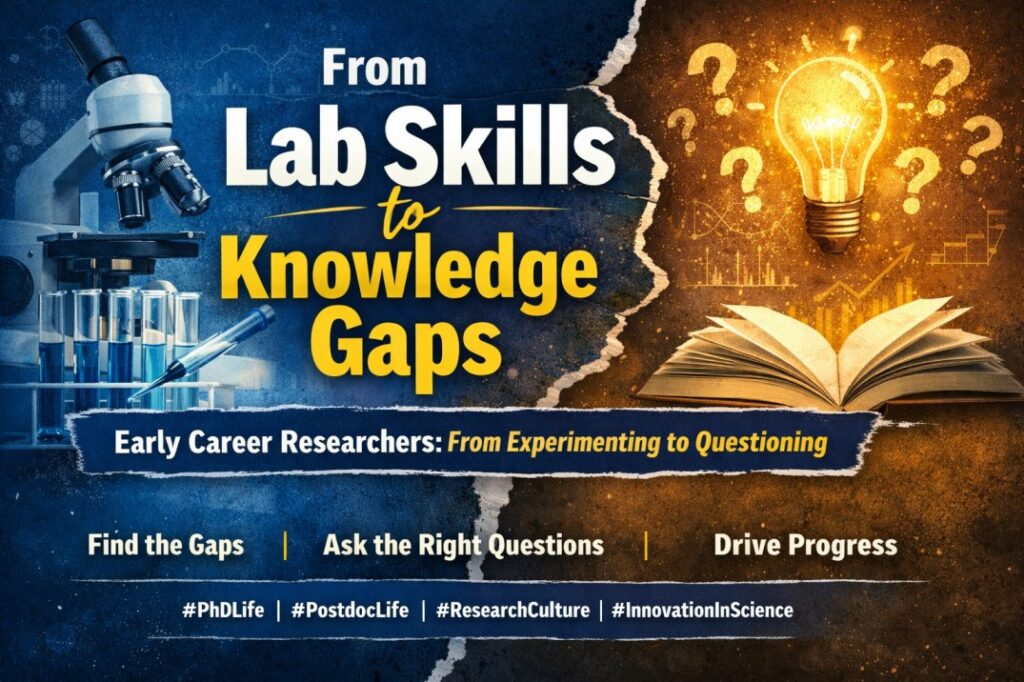
The real job of a researcher is not to run experiments. It is to identify knowledge gaps and fill them.
When ECRs continue to define themselves primarily as skilled operators—postdocs as senior technicians, research associates as advanced lab staff—they risk missing their intellectual mandate. Labs produce data. Researchers produce understanding. The difference lies in asking the right questions, challenging assumptions, and framing problems that actually move a field forward.
Knowledge poverty emerges when we have:
• Many experiments, but few original questions
• Many papers, but little conceptual advancement
• Many skilled hands, but not enough independent minds
ECRs are uniquely positioned to break this cycle. They are close enough to the bench to understand reality, and close enough to theory to challenge it. But this requires a shift in mindset—from
“What technique should I learn next?”
to
“What doesn’t my field understand yet, and why?”
Lab skills make you employable.
Intellectual ownership makes you a researcher.
If we want to reduce knowledge poverty, we must encourage ECRs to reclaim their primary role: gap-finders, not just task-performers; thinkers, not only doers.
The future of science depends not on how well we follow protocols, but on how boldly we question what we think we already know.